Status, November 15, 2026: the kiln is planned and not yet installed.
There is no lumber kiln running here yet. We're the people behind a working sawmill near Columbia, and we're planning to add a kiln that dries other people's lumber and slabs. If you have wet wood, or expect to, join the waitlist. Tell us what you'd bring and roughly how much, and we'll contact you when the kiln is ready to take a load.
Until the kiln is running, here's what we've learned about drying wood in mid-Missouri: how long it really takes here, what moisture content you need, what kilns charge elsewhere, and how to air-dry well in the meantime.
Where things stand
Nothing is being dried today, and we won't take wood in until the kiln is built, tested and ready. We'll update the status line above every month so you never have to guess.
The waitlist also decides what we build. A kiln sized for a few hundred board feet of hobby lumber is a different purchase from one that holds a trailer load of 8/4 oak, so the species, thickness and board feet people put on the form shape the size and type of kiln we choose.
What we plan to dry
The plan centers on hardwood lumber and live edge slabs from Missouri trees: oak, walnut, maple, ash, hickory, cherry and the rest of what grows here. We expect most of it to come from woodworkers, sawyers with their own mills, and people who had a tree milled and now have a stack of wet boards in the garage.
- Boards, 4/4 to 8/4. The bread and butter of any lumber kiln, and the stock that dries most predictably.
- Slabs. Wide slabs dry slower and crack more easily than boards, so they get gentler treatment and more time. See drying thick slabs.
Every species dries differently. White oak is the slowest and fussiest of the common Missouri woods; ash and soft maple give up water fast. Our species pages cover what each one needs.
Why kiln-dry at all in Missouri
Because air-dried wood in Missouri isn't dry enough for indoor furniture. Missouri's own extension service sets out the numbers: lumber dried outdoors here typically levels off at 12 to 14 percent moisture content, while indoor wood typically runs 6 to 10 percent (MU Extension G5507). Outdoor air simply can't take wood lower than the humidity allows. A board that's been stacked in a barn for three years is still several points too wet for a heated house.
That gap matters because wood shrinks as it loses moisture. Build a tabletop from boards at 13 percent, bring it into a house that holds the wood near 7 percent, and the top keeps shrinking after it's glued and finished. That's where cracked tabletops, open miter joints and gaps in flooring come from. Our moisture content guide works through the numbers by species.
A kiln closes that gap in days or weeks, under control. It also does two things air can't:
- It kills insects. Powderpost beetles and borers that came in with the log, or moved in while the stack sat outside, die when the wood is heated through. Air drying doesn't do that. Our sterilization page explains the temperatures.
- It can relieve drying stress. A well-run kiln finishes with a conditioning step that evens out the stress between the shell and core of each board, so it doesn't warp or pinch the saw when you rip it. See case hardening, honeycomb and checks.
How long drying takes here
Longer than most people expect. The USDA Forest Products Laboratory modeled air drying for Columbia, Missouri specifically: 1-inch red oak takes from about 7 weeks to about 5 months to reach 20 percent moisture content, depending on when you stack it, and 2-inch red oak takes roughly 7½ to 10½ months (FPL-GTR-121). And 20 percent is still a long way from furniture-dry.
A kiln finishes air-dried 4/4 hardwood in about a week. Thicker stock takes much longer, because drying time grows faster than thickness: by FPL's factors, 8/4 takes about two and a half times as long as 4/4, and 12/4 more than four times as long. The drying times page has the tables.
What drying usually costs
Other custom kilns around the country post rates in the $1-to-$2-per-board-foot range for lumber 2 inches thick or less, with minimum charges around $100 to $150. Thick slabs are often billed by the day or week in the kiln. Those are other operators' prices, not ours; we'll post our own rates when the kiln opens.
To see what your stack would run at those rates, use the estimator on our kiln drying cost page. If you don't know how many board feet you have, our guide to board feet for a drying load walks you through it.
What to do with your wood until then
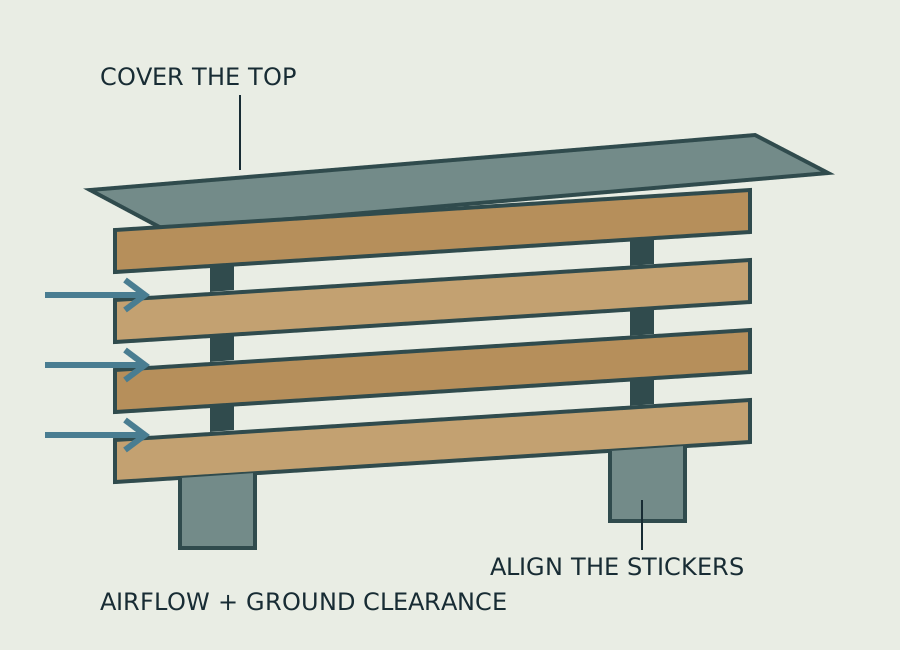
Don't let it sit wet in a pile. Wood that's stacked tight, left on the ground or kept in a hot, still garage can stain, mold and check in a single summer. The fix is cheap:
- Seal the ends of fresh boards and slabs the day they're sawn.
- Stack it on stickers, on a level foundation at least a foot off the ground, with stickers lined up over each support.
- Cover the top, not the sides, so air moves through the stack.
- Weight it so the top layers stay flat.
Our air drying guide covers each step, using MU Extension's recommendations for Missouri. Air drying first also shortens kiln time and lowers what a kiln will charge, so the work isn't wasted.
If you're not sure what you have, start with the guides or the FAQ.
Join the Waitlist
Tell us the species, thickness and rough board feet you'd want dried. There's no cost and no commitment, and your answers help us pick the right kiln.